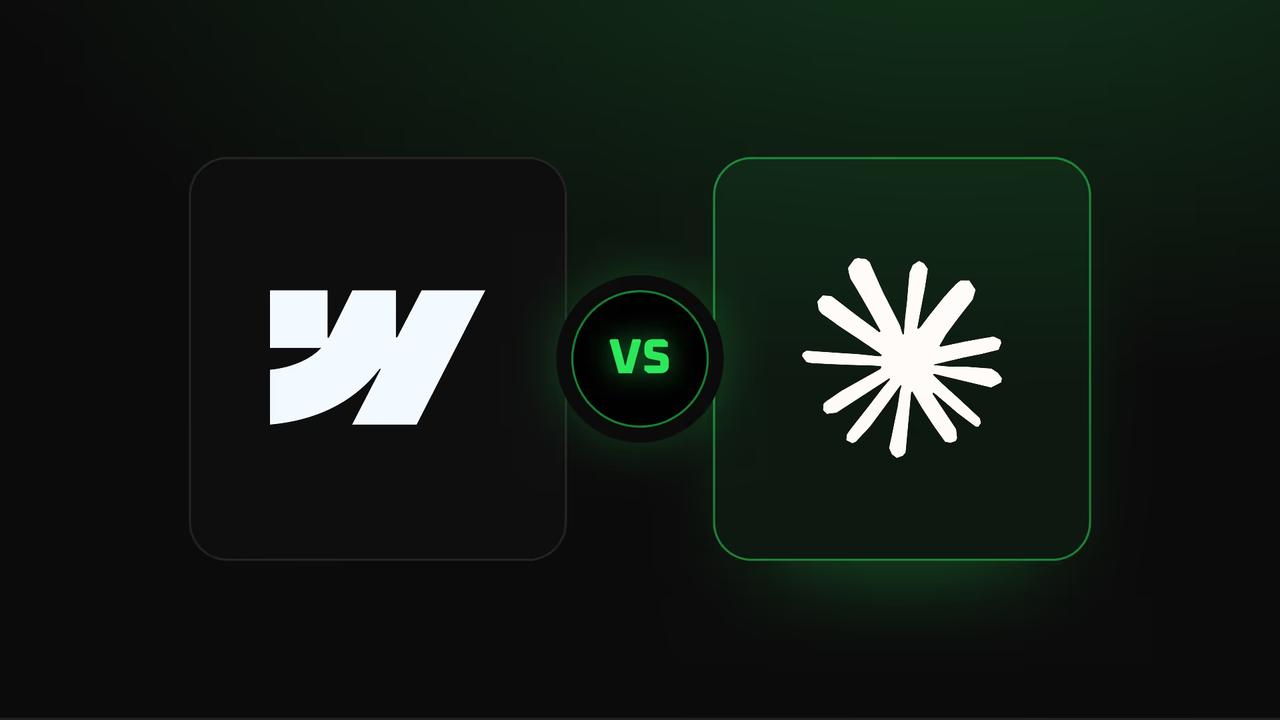
The short answer: Yes, if you prioritize pure velocity. No if your brand image is very distinctive and you want your marketing team to retain 100% control of your brand narrative while keeping autonomy to modify the website and create new pages from your established Webflow design system.
I'm a Webflow expert and I migrated my own website to agentic development. I made many interesting discoveries throughout this process, particularly about the reality of agentic development compared to using Webflow. I'm sharing all my findings in this article.
If you recognize yourself in one or more of these points, Webflow may no longer be the best option for your needs:
- Bandwidth costs become unpredictable as traffic grows.
- You need to automate the development of new pages with AI, but Claude MCP integration isn't enough.
- You've run into Webflow's frustrating limitations multiple times, especially when trying to do tasks that exceed the platform's native capabilities.
- You've added several features to Webflow's wishlist and they've never been developed after years.
- You've done every possible optimization to improve page load times, but you've hit the ceiling of what's realistically achievable.
- You're a tech company and you want the same velocity for your website updates as you do for your product development.
- You're starting to find the platform expensive and didn't appreciate Webflow's recent announced price increases.
- Your team is already using agentic development in their daily work.
If any of these points resonate with you, it might be time to consider migrating your website to a new technology stack powered by AI.
What exactly is agentic development?
Agentic AI isn't a chatbot or a simple writing tool—it's an autonomous intelligence system. It's an artificial intelligence system that acts: it plans, executes, and adjusts tasks autonomously, with execution that improves based on context. Agentic AI automates complex workflows, breaks down problems into sub-tasks to act on them, and transforms knowledge into concrete actions.
Concretely, an AI agent can:
- Ingest a CSV file of 500 product sheets and automatically generate optimized pages, URLs, SEO tags, and internal links—without human intervention.
- Interact with APIs and other external systems (CRM, Google Sheets, analytics tools) to orchestrate complete processes.
- Use feedback loops to analyze the result of an action, learn continuously and optimize over time.
- Adapt to dynamic environments with minimal human intervention, enabling rapid response to market changes.
The « agentic stack » often combines a headless CMS like Sanity, high-performance hosting like Vercel, serverless functions, and agent communication protocols like A2A or MCP to orchestrate everything. Assistants like Claude Code accelerate feature development at a speed that was unthinkable two years ago.
Concrete business gains with a modern agentic stack
Agentic AI systems can operate with minimal human oversight, and agentic AI uses feedback loops to optimize itself. But beyond the technology, here's what it changes for your bottom line:
- No invisible limits: no ceiling on the number of pages or articles with a CMS like Sanity.
- Exceptional page loading speed: with a single prompt, the website can achieve a score of 90 and above on Google Page Speed.
- Stable costs: end unpredictable bandwidth fees thanks to Vercel's serverless infrastructure, which optimizes resource usage in real time. Vercel offers hosting on a global CDN guaranteeing fast and efficient content distribution, as well as automatic scalability management to absorb traffic spikes without unexpected costs.
- Complete automation: agentic AI manages complex workflows - updating product sheets, generating pages at impressive speed. This automation isn't limited to simple tasks; it also allows orchestrating multiple business processes simultaneously, optimizing overall productivity. Thanks to its ability to interact with various APIs and external systems, agentic AI can synchronize data in real time, ensuring consistency and freshness of information on your site. Furthermore, this technology continuously learns from its actions through feedback loops, allowing it to improve its performance and adapt to market changes without constant human intervention. This approach offers a considerable strategic advantage for businesses looking to accelerate their web development while maintaining a high level of quality and consistency in their content.*
- Security and reliability: distributed architecture, no single point of failure. This architecture ensures that the site remains available even if a component fails, thus improving the overall resilience of the service. Furthermore, thanks to modern cloud infrastructure, protection against DDoS attacks and other threats is built-in, ensuring increased robustness against cybersecurity risks. This helps maintain customer confidence in your service and protects your digital resources. Finally, this technical reliability enables a smooth and consistent user experience, a key element for customer loyalty and visitor satisfaction.
- Unparalleled flexibility: Webflow is already very flexible thanks to its visual interface and integrated design system, making it an excellent site builder for most marketing needs. However, the agentic stack is natively designed for AI development, offering virtually unlimited possibilities. It allows you to create complex automated workflows, easily integrate advanced AI models, and quickly adapt features according to your company's specific needs.
- World-class hyper-performant product architecture: Can support large sites, offering uncompromising scalability and exceptional resilience against traffic spikes. This architecture relies on modern cloud infrastructure, including global CDNs and serverless functions, which optimize content distribution and automatic resource management in real time. The result is an ultra-fast website capable of maintaining a smooth user experience even under heavy load, with no risk of outages or performance degradation. This technical robustness is a major strategic advantage for growing businesses, allowing them to focus on their development without worrying about technical limitations.
Comparison table: Webflow vs agentic development
| Criteria | Webflow | Agentic development |
|---|---|---|
| Marketing team autonomy | High for a large marketing team thanks to an intuitive visual interface and an integrated design system that facilitates decision-making and autonomy in content creation and management. | Medium, less visual and more developer-oriented than for non-technical users |
| Page volume | Limited (~10,000 CMS items) | Unlimited |
| Execution speed | Manual, page by page. Claude's MCP integration remains limited. | Fast. Automated via agentic AI |
| Design control | Pixel-perfect | Faithful initially, more standardized afterwards. The initial migration is identical to the original, but future AI-generated page developments may require more adjustments |
| Predictable costs | Variable (bandwidth) | Stable with Vercel, variable depending on the number of AI tokens used |
| AI integrations | Limited | Native and scalable |
| Learning curve | Low for the content manager and visual interface. Medium to high for developing new components. | Low for using prompts to achieve goals and using the Sanity CMS, but moderate to high for understanding the interaction of different systems at play. |
| Small edits | Instant. Double-clicking on text or moving a block in the visual editor takes 2 seconds. | Heavier. Making a small text change or adjusting spacing via code with AI is more tedious. |
| Multilingual management | Simple and smooth. Webflow's native tools handle localization and translations very well. | More complex. Managing multilingual in a headless architecture (Sanity/Vercel) is more technical and rigid to configure. |
| SEO & page speed | Good, but limited by heavy code generated by the platform and closed-server optimization limitations. | Impressive. AI optimizes code, tags and structure natively. Combined with Vercel, the site reaches near-perfect speed scores. |
How we migrated our site in just 3 days (with no impact on Google)
When we decided to migrate our own site to an agentic stack, we expected a long and complex project. In reality, with a rigorous method, the transition went quickly and smoothly, in just three days:
- Day 1: Extraction and structuring
We exported the entire code from our Webflow site as well as all CMS collections. This first day allowed us to lay down the skeleton and overall structure in our new environment. At this stage, AI excels at recreating your current site identically (pixel-perfect), because it bases itself on your existing styles and code to guarantee complete visual continuity. - Day 2: Integrations and data connection
We reconnected all forms to ensure optimal functionality. Then we properly linked the database to the headless CMS Sanity, ensuring smooth management of content and information. - Day 3: In-depth testing and SEO optimization
This day was dedicated to meticulous verification, particularly ensuring perfect SEO data alignment so Google wouldn't perceive the site as a new entity. We also optimized performance to guarantee exceptional loading speed. Additionally, we performed extensive QA (quality assurance) to ensure all site functionalities and interactions work perfectly, without any regressions.
Concrete migration results
For Google, it's the same site, with no SEO loss whatsoever. In parallel, technical performance has been greatly improved: the site now benefits from ultra-fast loading speed, a key advantage for user experience and SEO. This rapid transition allowed us to immediately shift into agentic development mode, accelerating the creation of new pages and automating complex processes with unmatched velocity.
This method demonstrates that a migration to an agentic stack, combining artificial intelligence and modern solutions like Sanity and Vercel, is not only possible but also beneficial for companies seeking to gain performance and velocity in future updates.
Ready to migrate your Webflow site to agentic development?
We've been through this transition, optimized the process, and know exactly how to help you avoid technical pitfalls. If you feel your site is ready for its next technological upgrade, don't wait any longer.
Book your 15-minute diagnostic session
FAQ
How do I know if I should stay on Webflow or migrate? It all depends on your current priority: Migrate if you prioritize pure velocity and AI-driven automation above all. Stay on Webflow because it remains a very fast option to modify your site or create new pages independently from your existing design system, especially if your brand identity is very distinctive and you want to maintain 100% control over your brand narrative.
Will agentic AI replace my marketing team? No. Agentic AI can handle complex, multi-step tasks—production, testing, personalization—but strategy, creativity, and positioning decisions remain in your team's hands. Autonomy goes to the machine for repetitive tasks; strategic intelligence stays human.
Does migrating to Sanity + Vercel mean starting from scratch? Not at all. Your content, SEO data, and website design are transferred. It's continuity, not a complete redesign.
Will my site look exactly the same after migration? Yes. For migrating your existing site, AI is capable of cloning your current styles for an identical result.
Could I continue modifying pages with a visual canvas? No. This new technology stack doesn't currently support that.
How long does a typical partial migration take?It depends on the size of your website, it can take anywhere from a few days to a few weeks. Most sites can be migrated in 2-3 days.