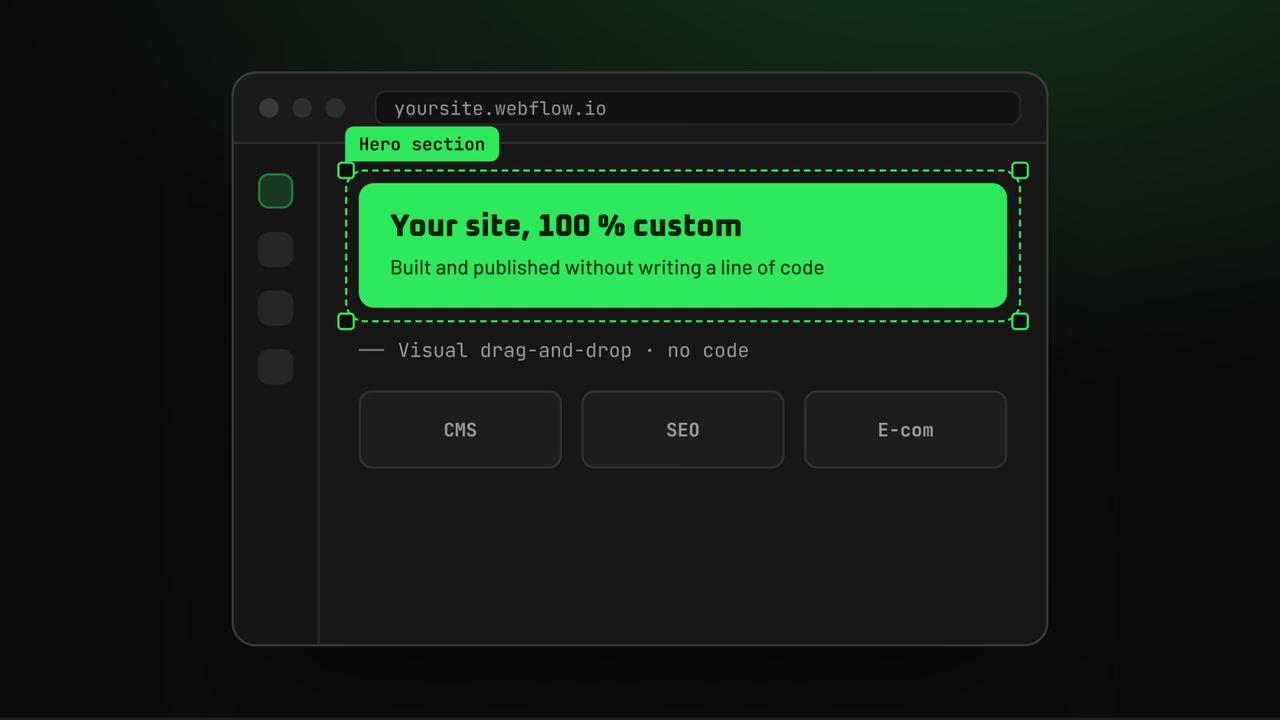
Webflow offers the ability to create websites and online stores tailored to your specific needs, without having to face the tedious task of coding manually. It's a solution that can be used for various applications and offers unique flexibility and ease of use.
Webflow: What exactly is it?
It's a website creation tool launched in 2013, accessible directly from your browser without any prior setup. It's particularly suitable for:
- Corporate websites: designed for marketing or a showcase site. This is indeed the context where it shines most.
- E-commerce online stores: which can contain up to 5000 products.
- Blogs: which can contain up to 20,000 articles.
The platform is suitable for both SMBs and large enterprises. It's used by companies like Anthropic (creators of Claude AI), Dropbox, Upwork, and Zendesk.
What makes Webflow different?
Webflow combines several essential aspects of web development in a unified interface. Unlike traditional CMS platforms like WordPress, which often require additional plugins and regular maintenance, Webflow natively integrates design, content management, and hosting features without any configuration needed. This integration reduces technical complexity and improves the overall security of your site.
Furthermore, Webflow offers a Designer mode that provides precise control over every visual element of the site, allowing for advanced customization without having to write code manually. This flexibility is particularly appreciated by UX/UI designers who want to create unique, engaging, and consistent user experiences without the help of a web developer.
Who is Webflow for?
Webflow is primarily designed for entrepreneurs, organizations, SMBs, and marketing teams who have outgrown the limitations of Wix or Squarespace, but don't want to get bogged down in the technical complexity of WordPress or custom code. It's the ideal tool for meeting agile marketing needs. The platform enables rapid time-to-market, while offering the ability to create a unique visual identity without resorting to generic templates.
While the platform is accessible to non-developers, building a website on Webflow requires a certain learning curve, as the platform uses web logic to visually construct interfaces. Some mastery is necessary to fully exploit its capabilities, particularly for complex or highly customized projects. The help of a Webflow expert is often needed to build the website correctly. However, the content manager (CMS) is very simple to use and even allows you to create pages from scratch with pre-configured components.
How does Webflow facilitate collaboration?
Another key advantage of Webflow is the ability to assign specific roles to each team member, such as content editor, designer, or administrator. This granularity allows you to work collaboratively without the risk of altering the design or structure of the site, while ensuring that each user has access appropriate to their responsibilities. This greatly facilitates web project management as a team.
An scalable and innovative platform
Webflow continues to innovate by regularly introducing new features such as artificial intelligence tool integration to accelerate site creation, improved no-code animations, the addition of third-party applications via a dedicated marketplace, as well as the Insights section. The latter offers detailed analytics on traffic, visitor behavior, and site performance, enabling users to make informed decisions to optimize their online presence.
Webflow's key strengths as a no-code platform:
Simplicity of CMS use
Webflow offers a rigorous visual interface that directly translates web code rules (HTML/CSS). Unlike classic drag-and-drop tools (like Wix), Webflow requires you to understand web structure to build a functional website. While creating the structure requires technical skills, day-to-day content management via Editor mode is remarkably simple for non-technical marketing teams.
This Editor mode allows you to modify content without risking breaking the website, thus offering more autonomy to marketing teams. The CMS makes it easy to create, edit, and organize pages, articles, products, or other types of dynamic content. Additionally, content collection management is flexible, offering the ability to structure data in a customized way for product catalogs, portfolios, or large blogs. With this approach, marketing teams can quickly publish updates, launch campaigns, or adjust elements without delay. Webflow also includes tools to preview changes in real-time and test their impact across different devices (desktop, tablet, mobile).
Speed of creating a custom website
Webflow allows you to create personalized websites more quickly, directly in the browser, for organizations of all sizes. This speed is facilitated by an intuitive interface that simplifies page layout and element addition without writing a single line of code. Moreover, thanks to the flexibility offered, it's possible to design unique layouts without being limited to pre-built templates.
Webflow integrates with Claude AI, thus accelerating the transition from design to technical implementation. This approach allows teams to gain autonomy on a daily basis, as it becomes possible to make changes to the site simply by using a few prompts, which greatly simplifies content management and evolution.
Flexibility to meet specific needs
Webflow offers numerous customization and development features, particularly through designer mode, which provides granular control over each element to precisely meet the requirements of each project. It also allows you to add animations without code. Developers can go further with custom code and more fine-grained HTML/CSS control. This Designer mode allows you to manage fonts, colors, spacing, and interactions with great precision, offering unmatched design flexibility for UX/UI professionals.
It's also possible to integrate external services and no-code tools, such as Memberstack, which integrate seamlessly with the platform to create advanced features such as membership spaces with protected access. Moreover, it's always possible to add custom code to further personalize your site and achieve exactly what you want. This option remains completely optional, allowing everyone to choose the level of complexity suited to their project.
Optimal search engine performance (SEO)
Websites created with the Webflow CMS include good SEO settings and facilitate the application of best practices to strengthen visibility. Managing meta tags, URLs, and 301 redirects is done easily. Alt tags for images are also integrated intuitively.
Furthermore, Webflow generates clean and optimized HTML, CSS, and JavaScript code, which contributes to fast page loading—an essential criterion for SEO. This technical optimization allows Webflow sites to achieve better scores on tools like Google PageSpeed Insights. Additionally, Webflow offers advanced options for managing structured data (schema.org), creating automatic XML sitemaps and customizing robots.txt files, key elements for effectively guiding Google's indexing.
Increased security and reliability
Webflow stands out with integrated, secure, and high-performance hosting based on AWS infrastructure, including a CDN to optimize loading times worldwide. Security updates and HTTPS support are handled automatically, unlike WordPress which requires regular and tedious third-party plugin management. This all-in-one approach simplifies life for users by offering a reliable and secure platform without requiring frequent technical interventions. Moreover, the Webflow environment is designed to protect user data and guarantee maximum availability, which is essential for maintaining visitor trust and ensuring business continuity online. This integrated hosting power also allows companies to focus on design and strategy rather than technical maintenance, while offering complete creative freedom and flexibility in content management through its high-performance content management system.
Minimal maintenance
This platform requires minimal maintenance, offering continuous, hassle-free operation for businesses. Indeed, Webflow automatically handles backups and server optimization, significantly reducing the risk of downtime or vulnerabilities. Since hosting is included in the subscription, this eliminates the need to manage an external provider and simplifies overall website management.
Fast page loading
Fast page loading performance contributes to an optimal user experience. Thanks to the CDN's global network of servers, latency is minimized regardless of visitors' geographic location. Webflow automatically optimizes images and scripts, which plays a key role in SEO, increases conversion rates, and reduces bounce rates across all device types, including mobile.
E-commerce features
Webflow also facilitates payment integration and inventory management. Its e-commerce plan starts at $29 per month, a solution particularly suited for small and medium-sized businesses looking to offer a personalized shopping experience without technical complexity. Webflow allows you to easily configure product catalogs, manage variants, taxes, and shipping options. Merchants can update their store in real-time, and integration with secure payment gateways like Stripe ensures reliable and fast transactions. However, it's important to note that Webflow is ideal for stores with a limited number of products, while Shopify remains superior for managing very large stores with an extensive catalog, thanks to more comprehensive back-end product management and advanced features suited for high volumes.
Conclusion
Webflow is much more than a simple website builder: it's an innovative platform that combines custom design, technical performance, and ease of use. Suitable for businesses of all sizes, it allows you to create showcase or e-commerce sites that are secure, fast, and optimized for SEO, while offering real autonomy to marketing teams through its easy-to-use CMS. Through its low-code environment and advanced features, Webflow facilitates collaboration between designers/developers and marketers, while integrating the latest innovations like artificial intelligence. By choosing Webflow, you invest in a scalable, reliable, and flexible solution that meets current and future web needs, making your online presence a true growth driver.