You don't need to speak technical to brief a Webflow agency wellbrief a Webflow agency. You need clear answers about your objectives, scope, access and site handover. That's where bad surprises hide, not in font choice.
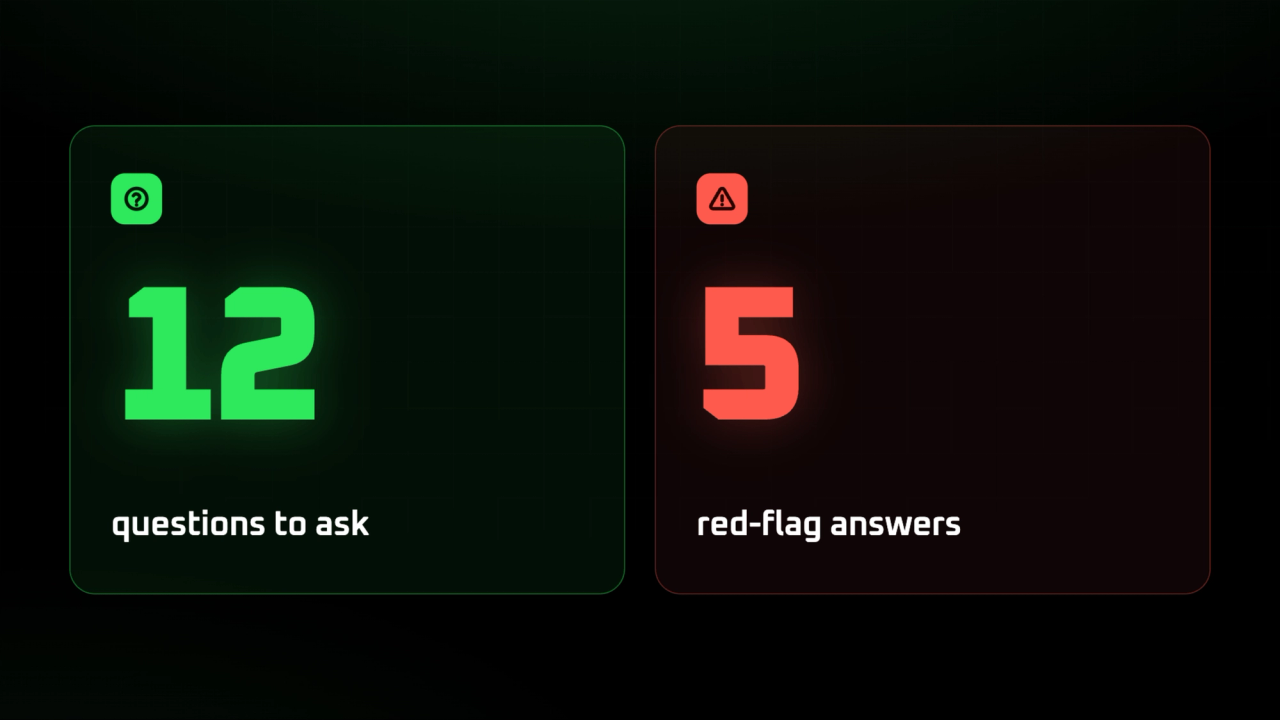
Here are 12 questions to ask, the proof to require for each one, and 5 answers that should make you think before signing.
Before briefing a Webflow agency, what decisions do you need to clarify?
Briefing a Webflow agency well starts with a simple question: what business problem do you want to solve, and how will you know it's solved?
Three frequent problems keep coming up: vague objectives, undefined audience, and no one responsible for approvals. A solid website brief reduces back-and-forth from the start and ensures the project delivers measurable results.
The one-page mini-brief to prepare before the first call
A good website brief fits on one page and covers five points:
- the main project objective;
- the target audience;
- the current problem;
- your constraints (budget, timeline, content, languages);
- the people who approve decisions.
Your brief also designates the person who can make a decision when something is blocking the timeline.
What questions protect your budget, deliverables and timeline?
Real scope is rarely hidden in the displayed price. It's hidden in what isn't written: content, translations, revisions, integrations, redirects, tests, and training.
The mention "organic search (SEO) included" is often vague. A clear website specification document lets you compare two proposals on the same basis.
How do you brief a Webflow agency on method and deliverables?
Request a document describing each step: discovery, architecture, wireframes in Figma (the interface design tool), integration, acceptance testing (tests before launch), and training. Also position your project between a visual Webflow approach and more advanced development, as explained in our articleWebflow vs custom development.
A redesign can also affect your SEO, forms and connected tools. Require three elements:
- a 301 redirect plan — the settings that prevent losing traffic from old URLs;
- test cases linking the site, form and your customer relationship management (CRM) tool — the software that centralizes your contacts;
- an inventory of integrations and data exchanges, sometimes via an application programming interface (API) — the bridge between two software systems.
Note: your organization remains responsible for obligations related to collecting personal information, even if the agency configures the tools or if a supplier (or subcontractor) is involved.
Ask the same twelve questions to each agency. The table below also serves as a basis for your website specification document:
| # | Question to ask | Why it matters | Proof to request |
|---|---|---|---|
| 1 | How do you transform our business objectives into measurable site objectives? | Avoids the "more modern" project with no expected outcome. | A priority action justified by a key performance indicator (KPI). |
| 2 | What do you verify before proposing a structure or mockups? | Separates user experience (UX) — how to use the website — from graphic production. | A written discovery method. |
| 3 | What content and decisions do we need to provide, and by what dates? | Content blocks the timeline more often than integration. | A dated client/agency matrix. |
| 4 | What is included, excluded, or only planned in the proposal? | Makes proposals comparable and eliminates vague language. | Scope line by line with the number of revisions. |
| 5 | Who is involved in strategy, UX, content, and integration? | A single role rarely covers the entire chain. | The expected deliverable from each team member. |
| 6 | What deliverables do we receive at each stage, and how do we approve them? | A 'design delivered' says nothing about the files provided or the expected final product. | A sequence of deliverables through to training. |
| 7 | How do you manage changes and additional requests? | Protects the budget when priorities evolve. | A written change process. |
| 8 | How do you preserve content, redirects, and SEO during a redesign? | Avoids treating SEO as an afterthought. | A 301 redirect plan. |
| 9 | How do you test forms, integrations and display on desktop, tablet and mobile? | Real problems occur between the site, the CRM and internal tools. | Privacy information accessible, consent collected if required, follow-up email sent, contact created in the CRM. |
| 10 | What access, roles and publishing rights will our team have upon delivery? | Content modification depends on specific rights, not a shared password. | Content management system (CMS), domain, Google Analytics 4 (GA4), CRM and form tools. |
| 11 | Who controls the Webflow workspace, the domain and billing, and how is the transfer organized? | Account control, billing and transfer are separate. | Written document: workspace, administrators, domain holder, integration accounts, billing and transfer timelines. |
| 12 | What happens the day after launch? | Delivery must cover training, support and handover. | An onboarding plan including initial support, ongoing maintenance and handover. |
What answers from a Webflow agency should alert you before signing?
The last three questions in the table touch on governance: access, account control and support after launch. Before choosing a Webflow agency, verify who decides, who holds the access and how the transfer happens.
An alerting answer is not an uncertain answer. It's an answer that evades responsibility.
The 5 answers that should alert you
| Answer heard | Why it's concerning | Answer to demand |
|---|---|---|
| "We'll handle content and SEO after the design." | Content, structure, and redirects shape the architecture. Delaying them complicates the project. | Demand a content inventory and redirect rules before integration. |
| "You own it, since you're paying for hosting." | Account control, domain, billing, and transfer are not the same thing. | Ask who controls the Webflow workspace and how the transfer is organized. |
| "Integrations are included." | Without naming specific tools, that phrase might mean a simple form—not the CRM flow or consent management. | Ask for specifics on data, accounts, configuration, testing, and third-party costs. |
| "We don't need your access or data before we start." | You can discuss without access, but you can't evaluate a migration or integration without an inventory. | Request a list of access needed by phase, through a secure channel. |
| "We handle security, you don't need to do anything." | Security is shared between the agency and your organization. | Ask who manages multi-factor authentication (MFA), backups, and incident response. |
A vendor asking for your content, a lead on your side, or a discovery workshop shouldn't slow things down. When choosing a Webflow agency, a refusal to quote a fixed price before seeing content, integrations, and migration details can be a good sign. Vagueness about process is the problem, not caution.
A serious agency makes the project clearer before making it more attractive.
The right choice is neither the fastest nor the most convincing.
It's not the agency that talks the most about Webflow or the one that promises the shortest timeline. It's the one that lays out its scope, limits, and your responsibilities.
Transform these twelve questions into a comparison grid and website specifications document. It's the simplest way to brief a Webflow agency well and keep control of your project.
Did you receive a difficult quote to compare, a redesign idea, or a still-vague brief?Prepare a precise scope definitionand validate access, scope, and priorities before signing.
Note: This article shares technical insights for Webflow, but does not replace legal advice. To confirm your compliance with Law 25, consult a legal advisor.