Expect 2 to 4 weeks for a professional Webflow showcase site, once your content is ready. A single page comes together in a few days. A site with a blog typically takes 4 to 8 weeks, while a custom project or store can take up to 12 weeks.
These timelines vary based on two factors: the scope of the site and who builds it. A beginner learning the tool will take longer than an experienced agency. Here are real timelines, without exaggerated promises.
| Timeline at a glance |
|---|
| Single page: 2 to 5 days. Showcase site: 2 to 4 weeks. Site with blog: 4 to 8 weeks. Store or custom project: 8 to 12 weeks, sometimes more. Content (text, images) is often what slows things down the most. Doing it yourself adds time to learn the tool. An agency delivers within a set and predictable timeline. |
How long on average for a Webflow site?
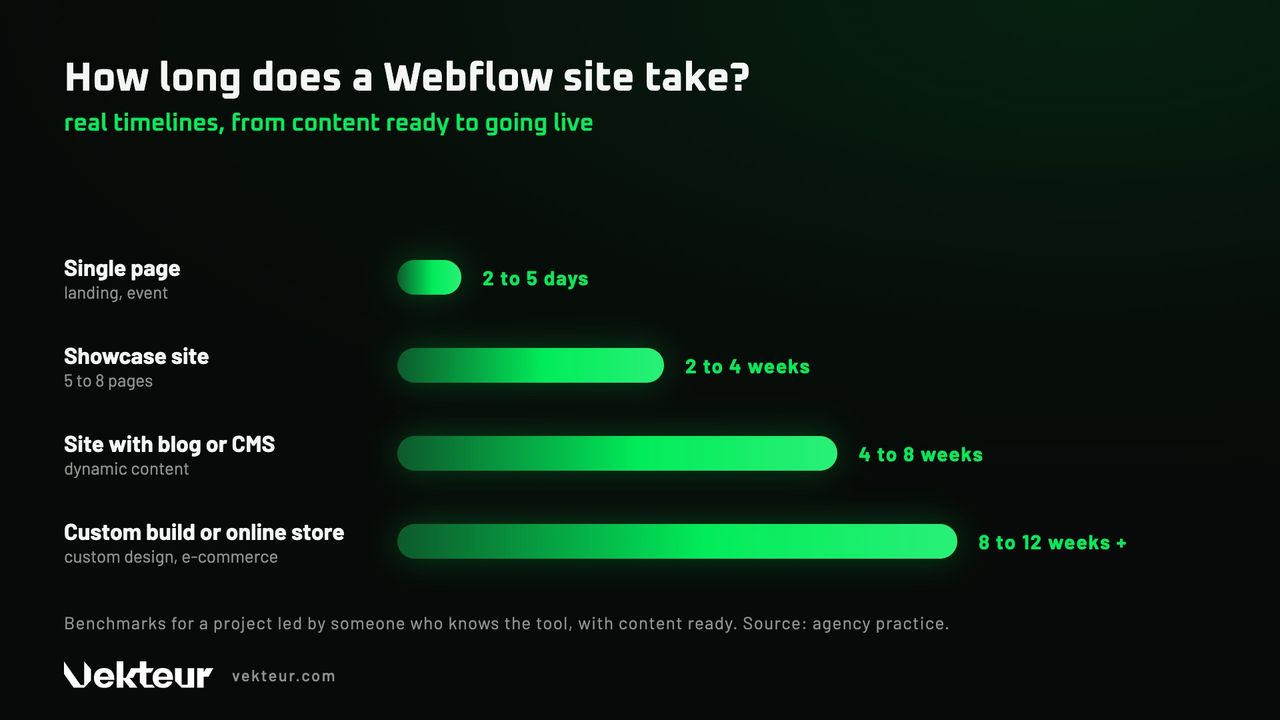
The timeline depends mainly on the scope of the site. A simple page comes together in a few days. A complete company website takes weeks. The table below gives realistic benchmarks.
| Site type | Realistic timeline |
|---|---|
| Single page (presentation, event) | 2 to 5 days |
| Showcase site (5 to 8 pages) | 2 to 4 weeks |
| Site with blog or CMS | 4 to 8 weeks |
| Custom website or online store | 8 to 12 weeks and more |
These benchmarks assume your content is ready and someone already comfortable with the tool. Otherwise, add time. The CMS (the system to manage your pages without coding) and the store always require more work.
| Launch » or « complete »? |
|---|
| Publishing a first version goes quickly. Finishing a complete, validated and filled site takes much more time. Our timelines aim for the finished site, ready to receive your visitors. |
What varies the timeline of a Webflow project
Five elements weigh on the duration of a Webflow project. Knowing them helps estimate yours. None is a surprise when you anticipate it.
The number of pages comes first. Five pages design quickly, thirty require a real timeline. Custom design (a unique mockup, not an off-the-shelf template) also adds time.
Dynamic content weighs heavily. A blog, portfolio or catalog goes through the CMS, so more structure to build. Online sales require even more adjustments.
Remains the most underestimated factor : your own content. Texts, photos and logos must be ready. Without them, the project waits, no matter how fast the designer.
| Factor | Effect on timeline |
|---|---|
| Number of pages | + a few days per batch of pages |
| Custom design | + 1 to 2 weeks vs a template |
| Blog or CMS | + 1 to 3 weeks of structure |
| Online store | + 2 to 4 weeks of adjustments |
| Content not ready | Blocks the project, unpredictable timeline |
| ⚠️ The trap that delays everything |
|---|
| Late content derails more projects than technical issues ever could. A site finished on the design side can wait weeks behind the scenes, simply waiting for final copy. |
Yourself, freelancer or agency: who's fastest?
At equal scope, the timeline changes depending on who's at the keyboard. A beginner learns as they build. A professional moves forward without that adaptation time.
| Who builds | Timeline (brochure site) | What matters |
|---|---|---|
| You, a beginner | 1 to 3 months | Learning the tool takes additional time |
| Freelancer | 2 to 4 weeks | Fast, but depending on other commitments |
| Webflow agency | 2 to 4 weeks | Defined and predictable timeline |
Doing it yourself always takes longer. You build skills along the way, and the first site progresses slowly. For a simple project without a set deadline, this approach makes sense.
A freelancer or an agency eliminates this learning phase. The agency adds a firm timeline and clear milestones. For a strategic site expected at a specific date, it's the safest option.
Budgets, on the other hand, differ significantly from one option to the other. Our article on Webflow pricing details each case.
A Webflow site in 2 days, is it possible?
Yes, it's absolutely possible. Starting from a template (a pre-designed site you adapt), you publish a page in one or two days. The result works, but remains generic.
The distinction matters. Publishing quickly isn't delivering a custom-built site. A barely modified template looks like thousands of others, without reflecting your brand.
This shortcut works to a specific need. An event page, a test idea or a temporary offer can accommodate it. For your company's main website, plan for the time of real work.
| Good to know |
|---|
| A template accelerates the start, never the thinking. Structure, content and brand image always require care. Many agencies start from an existing base, then rework it in depth for you. |
Building the site is not learning Webflow
Be careful not to confuse two separate durations . The time to build a site is not the time to master the tool. These are two separate clocks.
Learning Webflow takes a few days to a few weeks for a simple site. That's the subject of our article: do you need to know how to code for Webflow ? This skill development only happens once.
If you build it yourself, add the two together. First learning, then site design. An agency eliminates the first clock: its designers already master the tool.
| Two clocks not to mix |
|---|
| Learning the tool: a few days to a few weeks, once only. Building a given site: from a few days to several weeks, on each project. In an agency, only the second clock matters to you. |
How to get your site faster
A few simple habits significantly shorten a Webflow project . None of them sacrifice quality. They mostly avoid downtime.
Prepare your content before launching design. Gather text, images and logo from the start. This single step often saves one to two weeks.
Define the scope of the site next. A clear page list prevents additions along the way. Also approve each stage without delay, to limit back-and-forth.
Finally, delegate if the deadline is tight. A Webflow agency moves forward without a learning curve and keeps to a schedule. To understand what it builds, see how Webflow works.
| Our advice for meeting the deadline |
|---|
| Block a week before the project to gather all your content. Validate each step within 48 hours to keep the pace. Set a launch date from the start: a clear target saves time for everyone. |
A Webflow site delivered on your timeline?
You have a date in mind and need a site to match? Our team sets the schedule from the start and sticks to it.
Managing your content is up to you, without ever opening the code. Let's talk about your deadline.
Estimate my project timeline →
Frequently asked questions about Webflow site timelines
How long does it take to create a Webflow site?
Expect 2 to 4 weeks for a professional showcase site, content ready. A single page comes together in a few days. A site with a blog takes 4 to 8 weeks, a shop 8 to 12 weeks.
Can you create a Webflow site in one day?
Yes, from a template slightly customized. The site works, but remains generic. For true customization that reflects your brand, plan for several weeks.
How long does a Webflow showcase site take?
Expect 2 to 4 weeks once content is provided, for 5 to 8 pages. The timeline increases with the number of pages and custom design.
How long for a site with a blog?
Plan for 4 to 8 weeks.The blog goes through the CMS, which is more structured than a simple showcase site. The amount of content to integrate also plays a role.
Is it longer to build your own Webflow site?
Yes, significantly.You learn the tool at the same time you're building. Plan for 1 to 3 months for a first showcase site, learning included.
What slows down a Webflow project the most?
Late content, almost always. Late texts, photos and approvals block a project more than the technical side. Preparing everything upfront makes all the difference.
Will an agency really be faster?
Often yes, and especially more predictably.They don't waste time learning the tool and follow a structured timeline. You gain a firm deadline.
Does the timeline include time to learn Webflow?
Only if you build it yourself. By delegating, learning is off your calendar. Only the site design time remains.